


World Religions
.png)
CHRISTIANITY
At its most basic, Christianity is the faith tradition that focuses on the figure of Jesus Christ. In this context, faith refers both to the believers' act of trust and to the content of their faith. As a tradition, Christianity is more than a system of religious belief.
.png)
ISLAM
Muslims are monotheistic and worship one, all-knowing God, who in Arabic is known as Allah. Followers of Islam aim to live a life of complete submission to Allah. They believe that nothing can happen without Allah's permission, but humans have free will.
.png)
IRRELIGIOUS AND ATHEIST
Irreligion or nonreligion is the absence or rejection of religion, or indifference to it. Irreligion takes many forms, ranging from the casual and unaware to full-fledged philosophies such as secular humanism. Other examples are atheism, agnosticism and antitheism. Social scientists tend to define irreligion as a purely naturalist worldview that excludes a belief in anything supernatural. The broadest and loosest definition, serving as an upper limit, is the lack of religious identification, though many non-identifiers express metaphysical and even religious beliefs. The narrowest and strictest is subscribing to positive atheism.
.png)
HINDUISM
Hinduism is the world's oldest religion, according to many scholars, with roots and customs dating back more than 4,000 years. Today, with about 900 million followers, Hinduism is the third-largest religion behind Christianity and Islam. Roughly 95 percent of the world's Hindus live in India.
.png)
BUDDHISM
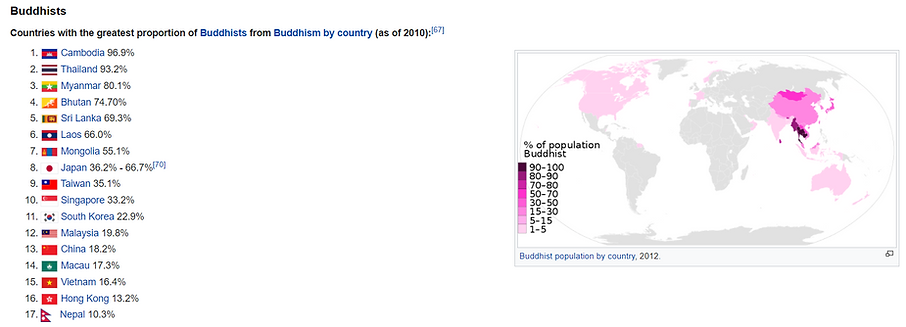
Buddhism is one of the world's largest religions and originated 2,500 years ago in India. Buddhists believe that the human life is one of suffering, and that meditation, spiritual and physical labor, and good behavior are the ways to achieve enlightenment, or nirvana.
.png)
TAOISM
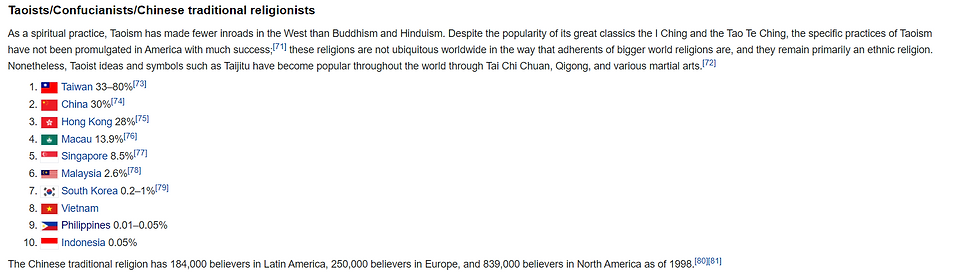
Taoism is an ancient tradition of philosophy and religious belief that is deeply rooted in Chinese customs and worldview.
Taoist ideas have become popular throughout the world through Tai Chi Chuan, Qigong, and various martial arts.
.png)
JUDAISM
Judaism, monotheistic religion developed among the ancient Hebrews. Judaism is characterized by a belief in one transcendent God who revealed himself to Abraham, Moses, and the Hebrew prophets and by a religious life in accordance with Scriptures and rabbinic traditions.
.png)
ETHNIC AND INDIGENOUS
.png)
SPIRITISM
In everyday Spanish and Portuguese, the word espiritismo refers to a wide range of beliefs—including African, Native American, and Western—that have to do with spirits and mediums (people who claim they can communicate with spirits). However, for people more versed in the distinctions among the various spirit-oriented religious and philosophical systems in Latin America, "spiritism" usually refers to the movement founded by the French educator Allan Kardec (born Hippolyte Léon Denizard Rivail).
.png)